

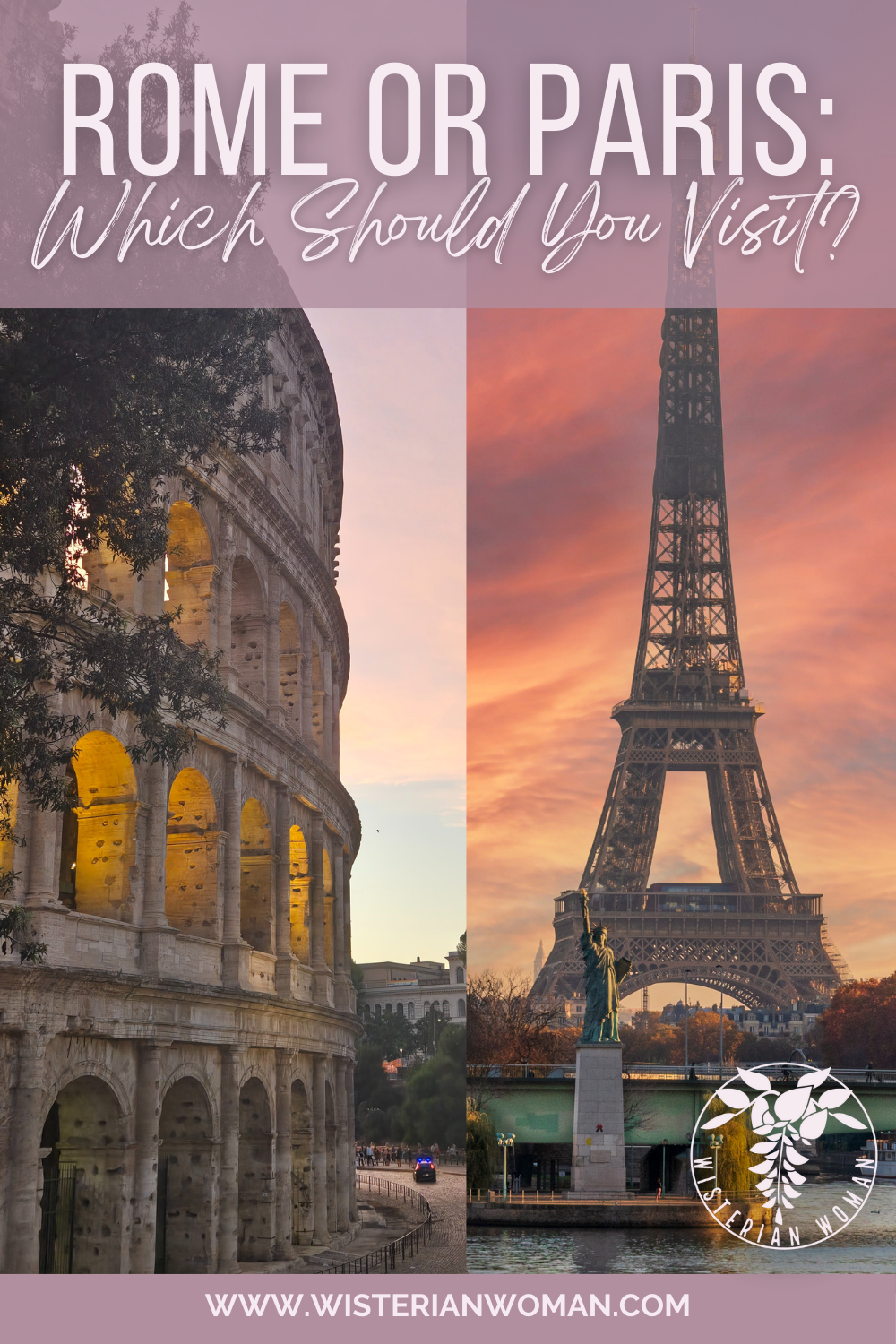
If you can only choose one city to visit—Rome or Paris—this comparison guide helps you decide by weighing key factors like friendliness to tourists, safety, food, must-see sights, history, and art. Whether you’re drawn to ancient ruins or iconic landmarks, find out which city offers the best experience for your adventure.
The Eternal City vs. The City of Love
Ah, Paris and Rome—the ultimate dream destinations for travelers seeking culture, history, and a touch of glamour. From savoring exquisite cuisine to exploring world-renowned art and centuries-old landmarks, both cities promise unforgettable experiences. But planning a trip to just one, let alone both, can be a challenge—not only are they not exactly close to one another, but each offers such distinct wonders that choosing between them feels almost impossible. So, if you’re lucky enough to visit one of these iconic cities, how do you decide which one to explore first—or which one deserves a spot on your bucket list?
I feel incredibly fortunate to have experienced both Paris and Rome, each as part of different EF Ultimate Break trips. During these curated adventures, I spent just three whirlwind days in each city before heading off to the next destination. Trying to capture the essence of these iconic places in such a short time was a thrilling challenge—every day was packed with non-stop exploration, from hotels to restaurants, museums, and more. Yet, amidst the hustle, I made it a priority to pause and truly soak in the magic of each city.
Let me start by saying that I would never dismiss an entire city as not worth visiting—every place has its unique charm and appeal. That said, I won’t shy away from admitting that, as a tourist, I found Rome to outshine Paris in almost every way. I know, that might sound a bit harsh. Don’t get me wrong—I truly enjoyed my time in Paris. But as someone exploring the ‘City of Love’ without a partner at the time, the experience felt, well, a bit overrated. In the rest of this article, I’ll break down why Rome captured my heart and why, in my opinion, it’s the better choice for travelers.
Overall Impressions of Paris and Rome
Friendliness to Tourists
To put it plainly, Paris can be a tough city for tourists, especially for Americans. While I tried to embrace the cultural differences, some aspects were hard to ignore. For instance, tipping isn’t customary in Paris, and in exchange, neither is customer service—at least not in the way Americans might expect. In most restaurants I visited, it felt like my enjoyment or satisfaction wasn’t much of a concern, and splitting the check? Forget about it.
For context, my visit to Paris was part of my first-ever trip to Europe, following a few days in Amsterdam. The contrast was striking: in Amsterdam, the Dutch people were friendly, many spoke English, and they seemed happy to help. Paris, on the other hand, was a culture shock. The Parisians I encountered didn’t seem interested in speaking English (which is completely fair—it’s their country), but the overall vibe often felt indifferent, if not outright annoyed, by tourists’ presence.
Rome, however, was a completely different story. The locals seemed genuinely happy to share their city with visitors. Whether it was explaining the history of a recipe, offering tips on sightseeing, or giving directions, the people of Rome exuded warmth and enthusiasm. It was clear they took pride in their city and wanted tourists to love it as much as they do. You’ll also be walking a lot, especially in Rome, so some comfy, stylish sneakers are a must.
To be fair, I’ve since returned to France, visiting the Riviera, where I found the people much kinder and more welcoming. Specifically, Antibes was one of my favorite stops of the whole tour. This leads me to believe that the perceived rudeness I experienced is a ‘Paris thing’ rather than a reflection of the entire country. Still, for a first-time tourist, the difference in attitudes between Paris and Rome was stark and unforgettable.
Safety Comparison of Paris and Rome
When I visited Paris in 2018, one thing our tour guide joked about stuck with me: Paris is often photographed from the second floor up because the first floor is often less glamorous, featuring graffiti, litter, and broken windows. While this humorously sets expectations, it highlights a reality that made parts of Paris feel less safe.

If you’ve never traveled to Europe, it’s common to see street vendors near major attractions in tourist cities. While this was definitely present in Rome, I found the vendors in Paris to be a bit more aggressive, often following our group, which made many of us—especially the women—uncomfortable. They were everywhere, and while I understand they’re just trying to make a living, some of their tactics felt unsettling. For example, we were warned by a local not to accept roses from strangers, as they might refuse to take them back and insist you pay for them—or, in more extreme cases, the roses could be laced with substances designed to disorient you.
In both cities, and in Europe as a whole, we were also warned of pickpocketing being very common. And looking like a tourist makes you a prime suspect. To keep your essentials safe while walking about, I’d highly recommend a lightweight crossbody bag that you can wear in the front, or even something a little more incognito to wear under your clothes. Avoid anything that buckles around you, as pickpockets are talented at releasing the clasp and running off.
Statistically, Paris tends to have a higher perceived level of crime compared to Rome. According to recent data from Numbeo, Paris has a Crime Index of 57.96, compared to Rome’s 48.93. Similarly, the Safety Scale in Paris is lower at 42.04, while Rome’s is higher at 51.07. Specific concerns like the risk of being mugged or robbed are rated higher in Paris (60.69) than in Rome (45.30), and people report feeling less safe walking alone at night in Paris (35.96) compared to Rome (45.99). While statistics don’t tell the whole story, they do align with my personal experiences.
During my stay in Paris, I avoided walking the streets at night, largely because the area around our hotel felt sketchy, with grimy surroundings and even a broken window just a block away. On the other hand, my experience in Rome felt somewhat safer. While I don’t recommend walking alone at night, I did end up doing so after staying out late to see the Colosseum lit up—a sight I couldn’t miss since it was just walking distance from our hotel. Though there were moments when I felt a bit uneasy, I passed by bustling, well-lit restaurants where locals seemed to be enjoying life late into the night, which gave me a sense of security. Ultimately, I made it back safely and found that Rome’s energy at night was more lively than intimidating.

Safety is subjective and can vary depending on the area you’re in and the circumstances, but for me, Rome felt more welcoming and less unsettling overall compared to Paris during my visit. And as a woman who frequently travels alone, this made a huge difference in my experience of each city.
Parisian vs. Roman Cuisine
When it comes to food, I have to give Paris the edge, even though French cuisine isn’t my personal favorite. Parisian dining has a distinct advantage: authenticity. Unlike Rome, where many restaurants near tourist hotspots cater heavily to visitors with staples like carbonara and cacio e pepe, Parisian establishments largely stick to their roots. Parisians’ notorious disregard for tourist preferences works in their favor here, as nearly every meal I had in Paris felt genuinely French. And let me tell you, the escargot was divine! From flaky pastries to rich, buttery dishes, it’s hard to go wrong with French cuisine.


That said, I absolutely loved my pasta spree in Rome. I indulged in bolognese, aglio e olio, and other classics—delicious, yes, but often tailored for tourists. When I ventured further afield during my trip to Florence, I discovered pasta that felt more authentic, less heavy, and more reflective of true Italian cooking. That’s not to say it’s all rich pasta dishes; one of my favorite “meals” simply consisted of bread, olive oil, and fresh caprese salad. And I’ll always remember the incredible Roman pizza our tour guide introduced us to at a local spot far from the tourist crowds. It was an unforgettable experience and one of the highlights of my culinary journey in Rome.


Both cities are modern culinary hubs, offering diverse cuisine from around the globe. I even had some exceptional sushi in Paris, proving that no matter your preferences, you’ll find something to love in either city. However, there’s one major distinction: customer service. If attentive, friendly service is important to you, you’ll find it in Rome, where the warmth of the locals extends to the dining experience. Paris, on the other hand, doesn’t prioritize this, and as I mentioned earlier, customer service isn’t really part of the cultural norm.
Ultimately, both cities have their culinary strengths. Paris excels in delivering authentic, buttery French cuisine, while Rome offers hearty Italian staples and, if you’re lucky enough to find the right spot, unforgettable local flavors.
Sights to See and Things to Do
Both Paris and Rome are cities teeming with unforgettable sights and experiences, from ancient ruins to world-renowned landmarks. Whether you’re wandering through the historic streets of Rome or marveling at Parisian architecture, each city offers its own unique allure. Let’s dive into some of the must-see attractions and iconic places that make both of these cities unforgettable travel destinations.
History: Ancient Gladiators vs. Modern Marvels
Paris and Rome both offer incredibly rich histories, but the type of history you’ll experience in each city couldn’t be more different. Your preference will likely depend on whether you’re more drawn to the elegance of centuries-old European monarchies or the awe-inspiring legacy of the ancient world.
Rome, often referred to as the Eternal City, is a dream destination for lovers of ancient history. The Colosseum alone is worth the trip—a monumental amphitheater where gladiators once fought and the grandeur of the Roman Empire was on full display. Walking through the Colosseum is stepping back 2,000 years, with every weathered stone whispering stories of the past. Not to mention the fascinating museum within its inner walls, where I discovered the Colosseum’s layered history before it became a protected site. I learned that after its abandonment, the Colosseum was repurposed in unexpected ways—serving as a residential area for squatters and even functioning as a bustling marketplace, akin to a farmers market.


But the history doesn’t stop there. The Pantheon, another awe-inspiring monument, stands as one of the best-preserved buildings of ancient Rome. Its massive dome, with an oculus at its center, continues to amaze visitors today, showcasing the genius of Roman engineering. The Roman Forum, once the center of Roman political and social life, offers a glimpse into the daily workings of one of the most influential civilizations in history. Nearby Palatine Hill is steeped in myth as the legendary site where Romulus founded Rome, and it provides breathtaking views of the city.


Beyond ancient Rome, the eternal city is also home to breathtaking churches that showcase its artistic and architectural grandeur. The Basilica di Sant’Agostino, for example, not only boasts a stunning painted ceiling that rivals the Sistine Chapel in its intricate beauty but also carries a rich history. Completed in 1483, its façade was constructed using travertine salvaged from the Colosseum, creating a tangible link between Rome’s ancient and Renaissance past. And speaking of the Sistine Chapel—that’s nearby too. We’ll cover more in the section on art.

On the other hand, Paris’s historical appeal is deeply rooted in its medieval, Renaissance, and revolutionary eras. Many of the city’s monuments are tributes to battles won during the French Revolution or honor the pivotal events of that transformative period. The Arc de Triomphe, commissioned by Napoleon, commemorates his military victories and serves as a symbol of national pride. The Place de la Bastille, though the prison itself is long gone, marks the site of the storming that sparked the Revolution, while the nearby Place de la Concorde is steeped in history, having witnessed both the Revolution and the fall of monarchies. For those fascinated by the French Revolution’s influence and the echoes of rebellion and reform, Paris offers an unparalleled opportunity to walk in the footsteps of history.

While Paris undoubtedly offers an incredible array of landmarks and historical treasures, many of its iconic experiences can also be found in Rome—albeit with a distinctly Italian Catholic twist. From grand basilicas to awe-inspiring art and architecture, Rome provides its own unique take on timeless wonders, seamlessly blending ancient history with spiritual and cultural significance.
For those who, like me, are captivated by the sheer weight of ancient history, Rome takes the crown. Standing in the heart of the Roman Empire, surrounded by structures that have endured for millennia, is an unforgettable experience. Paris, however, offers a more romantic and refined historical atmosphere, with iconic landmarks that echo its tumultuous and artistic past. Both cities have fascinating histories to explore, but if ancient ruins and the stories of emperors and gladiators speak to you, Rome is your city. If Revolutionary ideals and the shaping of modern France intrigue you, Paris has you covered.
Art and Museums: From Renaissance Masterpieces to Global Treasures
When it comes to art and museums, both Paris and Rome have awe-inspiring offerings, but each city takes a distinct approach to showcasing its culture and history through art. Whether you’re exploring intricate religious masterpieces or global art collections, the cities each offer experiences that will leave you in awe.
Rome’s art scene is unparalleled, especially within the Vatican City—an independent city-state surrounded by Rome itself. Although technically not part of Rome, the Vatican holds a treasure trove of religious and Renaissance art that is deeply intertwined with the city’s cultural and historical identity. The Vatican Museums, home to some of the world’s most famous works, including Michelangelo’s Sistine Chapel ceiling and Raphael’s frescoes, are a must-see for anyone fascinated by the intersection of art, religion, and history. The stunning beauty and intricate details of these masterpieces can make you feel as though you’ve stepped into the heart of the Renaissance. For art lovers, the Vatican is a once-in-a-lifetime experience that captures the essence of Rome itself—a city where art, religion, and culture have evolved hand in hand over millennia.


While Vatican City stands as a beacon of religious and Renaissance art, Paris brings its own unique flavor to the art world. The Louvre, one of the largest and most famous museums in the world, is an absolute must-see for anyone who loves art in all its forms. With collections spanning thousands of years and representing almost every culture and civilization, the Louvre offers a breathtaking, albeit overwhelming, experience. From the iconic “Mona Lisa” to the stunning sculptures of ancient Greece, there is something to marvel at around every corner. You could easily spend days in the Louvre, and even then, you’d barely scratch the surface of its extensive collections. That said, while it is a cultural gem, the sheer size of the museum can make it feel a bit spread out, with galleries that sometimes seem disconnected from one another. But don’t let that deter you—each exhibit you encounter will leave you in awe of humanity’s artistic achievements, from classical antiquity to the modern era.


Both the Vatican Museums and the Louvre are unparalleled in their collections, but the vibe of each is entirely different. The Vatican’s art is steeped in a history of devotion, faith, and religious expression, with many works commissioned by the Catholic Church to inspire and teach. Meanwhile, the Louvre offers a global perspective, with masterpieces from cultures across the world, both ancient and modern. In Paris, you’ll see art that spans the globe, including pieces looted during colonial times, showcasing the museum’s controversial history and the intersection of art with imperialism. In Rome, however, art and history are inextricably linked, with each piece telling a story about the rise and fall of empires, the spread of Christianity, and the artistic genius of the Renaissance.
The Hidden Gems and Unforgettable Landmarks
While we’ve covered the major highlights of Paris and Rome, there’s so much more to these cities than what we’ve already explored. Let’s take a moment to look at a few other must-see spots that might have slipped under the radar—or are simply worth revisiting.
In Paris, the beautiful river Seine adds to the city’s charm, and I was fortunate enough to experience it on a cruise. I was astonished at how many statues adorned the bridges, creating a picturesque atmosphere. Of course, the Eiffel Tower is a true icon of Paris, and I was pleasantly surprised by how much more beautiful it is in person than I imagined a metal sculpture could be. Did you know it sparkles every evening? The sight of it glittering against the Parisian skyline is truly magical, especially if you’re there during the winter months. I happened to be in Paris on New Year’s Day, and the air had a magical feel to it—something you just can’t explain until you experience it.


Another notable Paris attraction is its famous gardens, like the Jardin des Tuileries and Jardin du Luxembourg, although I missed experiencing them in full bloom during my winter visit. These gardens are a must-see when they’re in season, offering lush greenery, fountains, and beautiful walking paths—perfect for those who want to relax and enjoy nature within the city. Another highlight is the Notre Dame Cathedral, an iconic masterpiece of Gothic architecture. I was lucky enough to go inside and light a candle, which felt like a peaceful and spiritual moment amidst the grandeur of the cathedral. Though it’s undergoing restoration, the beauty and history of Notre Dame still shine through, making it a must-visit in Paris.


I also had the pleasure of visiting La Sainte-Chapelle, a lesser-known cathedral with absolutely stunning stained glass windows. The vibrant colors and intricate details of the glass were breathtaking, and the light filtering through them created an almost ethereal atmosphere inside. It’s a hidden gem that truly deserves to be on any Paris itinerary.


Rome, of course, has its own hidden gems. While we’ve already touched on the major landmarks, there are a few other must-sees that might surprise you. One of these is Villa Borghese, a beautiful park that also houses the Galleria Borghese, a museum filled with works by Caravaggio, Bernini, and other great artists. The park itself is perfect for a peaceful escape from the hustle and bustle of the city. Also, don’t miss the monument my tour guide (not so lovingly) called “the wedding cake”—the monument to Victor Emmanuel II, the first king who united Italy. This grand structure sits atop a hill, making it hard to miss, and it’s a striking reminder of Rome’s pivotal role in shaping modern Italy.

But one thing you can’t miss in Rome is the many fountains scattered throughout the city. The Romans were incredibly proud of their invention of aqueducts, and their fountains are a testament to this engineering marvel. From the world-famous Trevi Fountain to the smaller, hidden gems tucked in various piazzas, these fountains add to the city’s beauty and charm. Many of them have intricate sculptures and flowing water that harken back to Rome’s ancient glory, making them a must-see for anyone visiting the Eternal City. Don’t forget to pack a refillable water bottle with a filter—Roman fountains are famous for clean drinking water, and most restaurants in Europe don’t serve tap water for free with your meal like they do in the states.

While I didn’t get the chance to see all these places on my trips to Paris or Rome, I guess that just means I’ll have to go back. Both cities are filled with surprises—whether it’s the magic of the Eiffel Tower sparkling against the Parisian sky or the hidden beauty of a Roman garden or museum. One thing I was amazed by in both of these cities was how they’re not afraid to show off. Marble statues adorned with gold will just casually be sitting near the sidewalk—like, no one’s gonna steal that? It’s incredible how these stunning works of art are just integrated into everyday life. You could easily spend weeks exploring these cities and still find something new around every corner. But sometimes, it’s the unexpected moments—the quiet strolls through tranquil parks, the street vendors showcasing their music or craft, or the golden hour light hitting a monument just right—that create the most memorable experiences.
Rome or Paris? And the Winner is…
While both cities have their own unique treasures, Rome’s ability to seamlessly blend ancient history with modern vibrancy, its warm and welcoming locals, and its deeply-rooted culture make it the city that steals the show. Yes, Paris has its undeniable charm, iconic landmarks, and cultural cachet, but in the end, Rome offers everything Paris does—and more. The history is older, the vibe more relaxed, and the local experiences feel more personal. Whether it’s the grandeur of the Colosseum, the beauty of the Roman Forum, or the insanely delicious flavors of authentic Roman pizza, Rome is a city that effortlessly captivates, offering travelers an unforgettable journey through time and culture.


And so, while Paris might still hold a special place in the hearts of many, there’s a reason Rome continues to rise as the ultimate European destination. It’s a place where every street corner offers a new piece of history, where every meal is an invitation to savor la dolce vita, and where the warmth of its people leaves you feeling like you’ve found a second home. If you’re seeking an enriching and immersive travel experience, Rome is the place where your dreams come alive. It has everything Paris has to offer and more, in my humble opinion. Except, of course, for Paris itself and the best croissant(s) au chocolat in the world.

more like this






Leave a Reply