
28 Candles and an Open Road
I had just blown out 28 birthday candles.
Work had me totally burnt out—living for the weekend, running on fumes. Most days I felt like I was just getting through, and even on weekends, it took everything in me to hit the gym or try to get outside and hike now that the weather had finally turned.
I wasn’t unhappy. Just… restless.
I’d taken a few days off for my birthday. There was a small get-together planned with friends on Saturday, but it was only Wednesday, and rain was in the forecast at home for the next two days. I found myself itching to go somewhere. I checked everywhere within a two-hour drive—also rain. And then I remembered Moab.
I’d been there once, kind of. Just a brief pass-through on a road trip from Scottsdale to the Grand Canyon, and then home to Colorado. We did the scenic drive through Arches and stopped at the Windows section. I remember thinking it was cool—but not that awe-inspiring. But I remembered that there were two national parks near Moab, and started reading about Canyonlands. The more I read, the more I knew: this was where I needed to go.
The Drive to Moab & The Plan
Moab is about six hours from where I live, and that sounded just far enough away, but not too far for a 2-day trip with a one-day itinerary.
I threw together a last-minute road trip setup: my new Igloo mini cooler, my favorite travel backpack, a car air mattress I’d been meaning to test out, and—yes—a fresh can of bear mace. (Bears aren’t super common in Moab, but hey, better safe than sorry. Also, let’s be honest, bear mace works on more than just bears.)
I packed sandwiches, trail mix, protein coffees and drinks, and enough water to hydrate a small army. Desert dehydration is real.
By 6 a.m. the next morning, I was on the road. Luckily the road from Colorado to Utah on i-70 is quite beautiful, so while 6 hours felt like a lot, at least I had a beautiful view as the rocky, snow-capped mountains slowly changed to red rock formations.

Canyonlands National Park
After a few stops for gas and snacks, I rolled into Canyonlands National Park just before noon. For the next six hours, I explored every overlook I could find—Grand View Point, Buck Canyon, Green River. I climbed Whale Rock, the red dirt clinging to my boots, and stood at the edge of cliffs that felt like they belonged to another planet.
I hiked the trail off Grand View Point, and despite it being a peak time of day, it was blissfully uncrowded. The further I walked, the more solitude I found. It was quiet—otherworldly, even—and offered views that made you feel like you were hovering above the Earth itself. A curious raven followed me for a bit, calling softly in the light rain as I walked.

But the place that truly made my jaw drop was Upheaval Dome.
It looked like something ripped straight out of a sci-fi movie: a jagged crater of swirling, shattered rock in stark contrast to the smooth red mesas that define most of the park. The moment I walked up to the overlook, I audibly said “whoa.” Geologists aren’t entirely sure how Upheaval Dome was formed—it’s been the subject of decades of debate. Some believe it’s the collapsed remnant of a salt dome, others think it’s the aftermath of a meteor impact.

I’m not a scientist—but standing there, it definitely looked like a meteor hit. A giant one.
The scale, the color contrast, the sense of mystery—it was mesmerizing. And surprisingly, it wasn’t crowded either. Just a few of us up there, quietly taking it in.
Canyonlands National Park Overview & History
Canyonlands doesn’t always get the same hype as Arches, but it should. This place is massive—337,598 acres of sculpted desert wilderness carved by the Colorado and Green Rivers. It was officially designated a national park in 1964, thanks to efforts by President Lyndon B. Johnson, after years of growing appreciation for its geologic significance and raw beauty. Before that, it was remote ranching and uranium mining territory.
The park’s defining features are the canyons, mesas, buttes, arches, and spires that have been shaped by over 300 million years of erosion and uplift. You’re essentially walking through ancient seabeds and sandstone layers—Wingate, Navajo, Kayenta, and Chinle—each one telling a chapter in Earth’s deep history. Standing at the edge of Grand View Point, it’s hard not to feel like time itself is layered in those walls.
Canyonlands is divided into three distinct districts, each separated by geography and character:
- Island in the Sky (where I spent my time) is the most accessible, perched on a high mesa 1,000 feet above the surrounding canyons. It’s known for panoramic overlooks, short hikes, and drive-up viewpoints that are nothing short of jaw-dropping.
- The Needles lies two hours south and feels more rugged and remote. It’s a paradise for hikers, dotted with striped spires and sandstone fins that rise like fingers from the desert floor. The trails are long, but I’ve been told they’re well worth the effort.
- And then there’s The Maze, one of the most isolated areas in the national park system. It’s only accessible by 4WD and only recommended for experienced adventurers. This section remains largely untouched—wild and mysterious.
What’s unique is that you can’t drive directly between any of the districts. They’re spread out and separated by canyons and rivers, which means if you want to explore more than one, you need time and a good plan.
Camping at Canyonlands
By around 6pm, I was getting tired and considered where I’d camp. I’d looked into dispersed camping or staying at nearby primitive campgrounds, but being a solo female traveler, I was a little uneasy about being completely alone on a backroad. The only official campground in Canyonlands’ Island in the Sky district has 12 spots. Twelve. For the entire most-populated section of the park.
I figured there was no chance, but I drove by anyway. And somehow—miraculously—there were four spots open. I snagged one instantly and paid the $15 fee with no hesitation or regret. Surprisingly, they also accepted credit card payments which was perfect because I only had a $20 bill and there was nowhere to make change.
A Perfect Night Under the Stars
The site was walking distance from the Green River Overlook, where I caught a beautiful sunset, albeit a little obscured by the clouds rolling in. I ate warm soup from my thermos as the sky turned lavender and orange, then walked back and cracked open Wild by Cheryl Strayed—a book I’ve owned forever, but never read. (Spoiler: it’s worth it.) Her story of grief, transformation, and hiking alone through unknown wilderness hit me in a way it wouldn’t have a few years ago. There was something powerful about reading it out there—under desert skies, miles from anywhere, after a long day of hiking and being totally with myself. It was the perfect companion for a night like that.
Rain fell lightly on the roof of my car as I drifted to sleep.
And then I spontaneously woke up at 3 a.m.—to the vast, bright Milky Way shining through the glass roof of my car.

No words. Just gratitude. And some epic pictures.
Sunrise at Mesa Arch
My plan for Thursday was to wake up at 5:20 and catch sunrise at Mesa Arch.
Spoiler: I almost didn’t go.
When the alarm went off, I turned it off and laid there, too tired, too sore. But something in me whispered that I’d regret skipping it—and that whisper was right. So I threw on layers, slipped on my hiking boots, and hit the trail.
It’s only a 0.45-mile hike to Mesa Arch, which is probably the best investment-to-reward ratio you’ll ever get for a sunrise hike. A short walk for one of the most iconic desert views in the world. I had been warned by other travelers the day before that I might have to throw elbows to secure a good spot—Mesa Arch is incredibly popular among photographers and hobbyists, and it’s not uncommon for tripods to be lined up shoulder to shoulder in the early morning dark.
But once again, Moab surprised me.
When I arrived, there were only about ten people total. A mom and her kids were heating up coffee on a little camp stove, another photographer already had his camera in place, and a handful of other early risers were quietly scattered around, waiting for the show. The atmosphere was relaxed, friendly, even reverent. I snagged a perfect spot without issue and set up my tripod.
And then we waited.
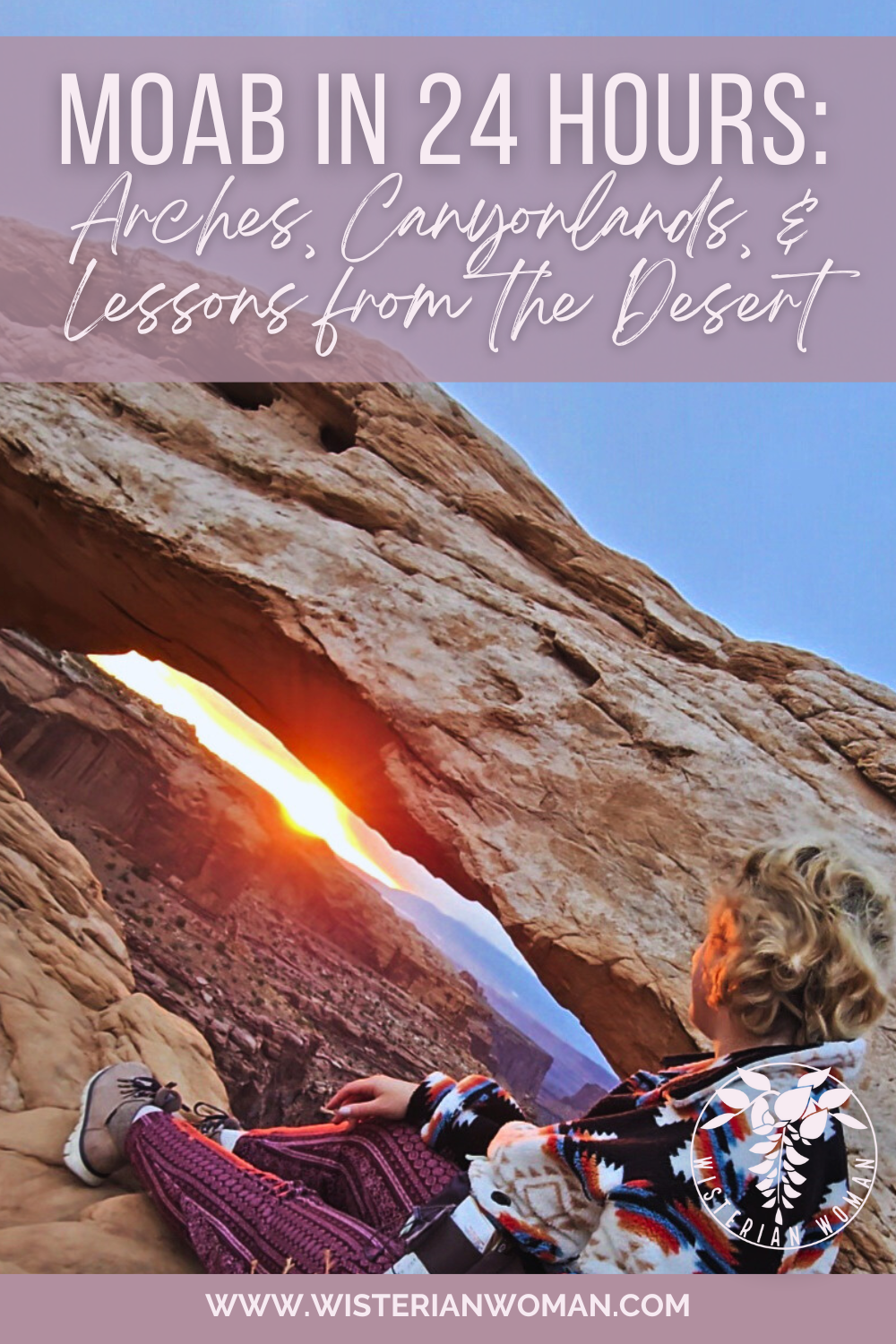
Watching the sun rise through Mesa Arch, casting golden fire across the canyon walls and the vast desert below, was something I’ll remember for the rest of my life. The arch glowed from the inside out, as if lit by flame. It was every bit as magical as they say—maybe more so because it didn’t feel like a chaotic tourist trap. It felt earned.

One Last Detour: Arches National Park
My original plan had been to drive two hours south to the Needles District of Canyonlands and attempt either Druid Arch (8 miles) or the Chesler Park Loop (11 miles), but my body said nope. I was already sore and worn out from the day before, so I pivoted.
Instead, I grabbed a last-minute timed entry for Arches National Park (bless weekday travel) and headed in to explore what I hadn’t really seen on that first trip a few years ago.
Arches is smaller and more accessible than Canyonlands, but no less impressive. It protects over 2,000 natural stone arch formations—the largest concentration of natural arches anywhere in the world. The park’s red rock landscape is sculpted by millions of years of erosion, weathering, and time, and yet somehow still feels timeless.
Double Arch took my breath away—an easy, sandy walk to a soaring cathedral of stone that towers above you like something from another planet. Unlike some of the more strenuous hikes, this one’s short, flat, and delivers big payoff with minimal effort. You can stand beneath the arches, craning your neck to take in the massive span overhead, and feel both small and completely awe-struck.

I skipped the full Delicate Arch trail this time—it’s only 3 miles round trip, but with a steep incline and the sun beating down, I just didn’t have it in me. Instead, I chose the upper viewpoint, which still offers a striking (if distant) view of Utah’s most iconic arch. It was the right choice for where I was physically—and honestly, it gave me a new kind of appreciation for the arch, silhouetted against the open desert sky.


I took my time on the scenic drive through the park, pulling off at overlooks I hadn’t seen before, savoring those final few moments of red rock magic. One last stop at the visitor center for a souvenir, and then… it was time. Time to drive home. Time to carry the stillness with me.
Homebound, But Recharged
By noon, I was back on the road. Sore, sun-kissed, and deeply content.
I hadn’t planned this trip. I didn’t have an itinerary or expectations. I just went—because something in me needed it.
It turns out, the desert has a funny way of giving you exactly what you didn’t know you needed.
What the Desert Taught Me in Just 24 Hours
I didn’t come to the desert looking for answers. I didn’t even come with questions, really. I came because I was tired. Burnt out. Restless in that subtle, gnawing way where everything is fine, technically, but you feel like you might slowly disintegrate if something doesn’t change soon. You know the feeling?
Work had me drained. Life felt like an endless to-do list. I had just blown out 28 birthday candles and realized I’d been living for the weekends—and even those were starting to blur into errands, exhaustion, and trying to “reset” before Monday rolled around again. So when I saw two rainy days in the forecast, something in me snapped. Or maybe, finally, something awakened.
I packed up and drove six hours to Moab, Utah. Alone.
And in just 24 hours, the desert gave me more clarity than I’ve felt in months.
You don’t need to know the plan to take the next step.
I didn’t have a grand itinerary. I wasn’t even sure where I’d sleep that night. But I drove anyway. I trusted that somewhere out there—beyond the cell signal and familiar routines—was something I needed. And maybe that was enough.
The desert doesn’t move with urgency. It doesn’t rush to bloom or worry about who’s watching. It just exists, fully and unapologetically. And somehow, that gave me permission to do the same.
Solitude isn’t empty. It’s sacred.
I’ve traveled solo before—some of my favorite memories have come from going it alone. There’s something empowering about trusting yourself to navigate new places, to set the pace, to decide what matters most in the moment. But being alone in the desert? That’s a different kind of solitude.
Canyonlands isn’t just quiet—it’s ancient, vast, and reverent. The stillness out there doesn’t echo; it absorbs. And somehow, in all that space, I didn’t feel isolated—I felt held.
I walked trails without seeing another person. I listened to the wind carve its way through the canyons. I stood in places that made time feel irrelevant. And for once, I didn’t try to fill the silence with music or thoughts or to-do lists. I let it be loud in its own way. I let it speak.

Not everything has to be hard to be meaningful.
I’ve spent so much of my life thinking that things only count if I’ve earned them the hard way—if they come with hustle or sweat or some inner battle. But Mesa Arch? It was a half-mile walk. Easy. And still, watching the sun rise through that glowing archway felt like a spiritual experience.
Not everything has to be hard to be beautiful. Sometimes, grace shows up softly.
Mystery doesn’t need solving to be powerful.
I stood at Upheaval Dome, staring into this strange, broken circle of land that geologists still debate—salt dome? Meteor strike? No one really knows. And I realized something: not knowing didn’t make it less awe-inspiring.
There’s a lesson there. We spend so much time trying to name things, label them, explain them away. But maybe some things are meant to remain mysteries—sacred, unexplainable reminders that we’re not in control of everything. And maybe that’s okay.
Rest isn’t weakness—it’s wisdom.
I didn’t do every hike I had planned. I skipped the longer trails. I slept in. I listened to my body, which was something I’ve ignored more times than I care to admit.
In the desert, I was reminded that pushing through isn’t always brave—sometimes rest is the most radical thing you can choose. And it’s the thing that lets your soul catch up with your body.

In just 24 hours, the desert gave me space to remember myself. Not the version that shows up to meetings or answers emails or holds it all together. The real me—the one that breathes a little deeper under open skies, that feels wonder flicker behind her eyes when she stares at a canyon carved over millions of years.
I didn’t find answers out there. But I did find stillness, perspective, and a reminder that my life doesn’t need to be full to be meaningful. Sometimes, it just needs to feel mine.
Quick Tips If You Go:
- Weekdays are gold. Campgrounds and timed entries are way easier to get.
- Solo travel safety matters. Tell someone where you’ll be, and trust your gut when something feels off.
- Pack for desert extremes. Bring way more water than you think, layers for the cold, and protection from sun and rain.
- Be flexible. Your body might tap out before your heart does. Listen to it.
- Don’t skip Mesa Arch at sunrise. Seriously.
Whether you’re chasing a reset, a little solitude, or just a last-minute adventure, Moab has a way of meeting you where you’re at—and then quietly shifting something inside you. I went looking for sunshine and space. I left with clarity, calm, and a deeper appreciation for how much 24 hours can hold when you let yourself go.

more like this





Leave a Reply